Blowing room-temperature air
Dirty coils, a fan motor or a compressor fault.
Packaged terminal units heat and cool one room each, in apartments, hotels, senior housing and offices. We repair them, replace them unit by unit and keep the sleeves weathertight.
The short answer
PTAC service in Grand Rapids covers the self-contained heating and cooling units that sit in a wall sleeve under a window in apartments, hotel rooms and offices. Most failures are a dirty coil, a failed fan motor, a control board or a heat strip, and most are repaired in one visit. Replacements slide into the existing sleeve when the size matches.
What you might notice
Dirty coils, a fan motor or a compressor fault.
Blocked drain or sleeve tilt.
Loose panels, fan blade or failing motor.
A shorted heater or compressor.
Worn sleeve gaskets and caulking.
One room, one unit
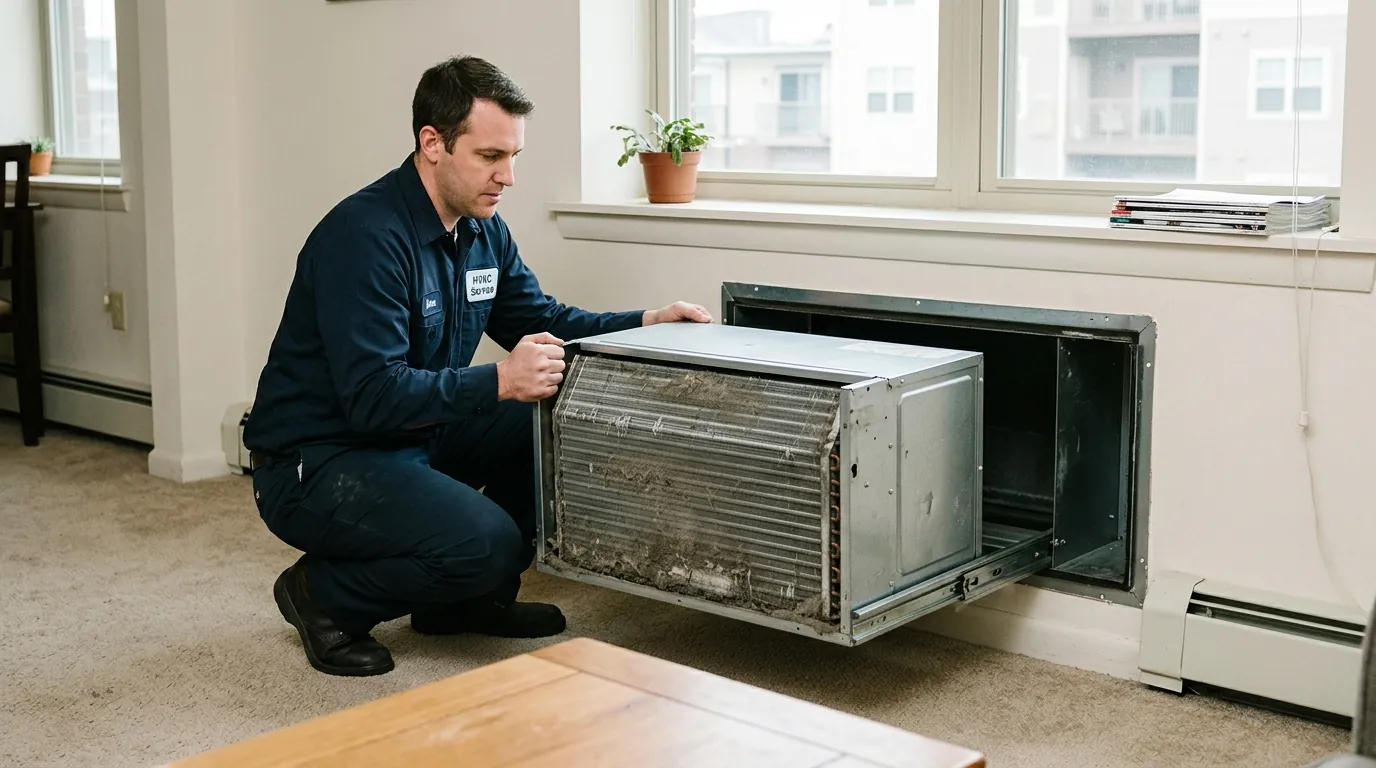
A PTAC holds a compressor, two coils, fans, a heat strip or heat pump and the controls in one chassis that slides into a sleeve through the outside wall. Because each unit serves one room and runs hard, dust, lint and outdoor debris build up quickly, and the failures repeat across a building.
Buildings with many units benefit from scheduled filter and coil cleaning through commercial maintenance. Rooftop and split equipment is covered under commercial HVAC repair in Grand Rapids.
The jobs we do
The most common PTAC complaints are no cooling, no heat, noise and water on the floor. No cooling usually traces to a dirty outdoor coil, a failed fan motor or a compressor that will not start. No heat points to a failed heat strip, a tripped thermal limit or, on heat pump models, a reversing valve or defrost fault. We test the chassis on the bench or in the sleeve, clean both coils while it is out, and replace the failed part so the unit goes back into service the same visit where the part is available.
When a chassis is old or the compressor has failed, replacing the whole chassis is usually cheaper than a major repair. Most modern PTACs use a standard sleeve size, so a new chassis slides into the existing sleeve with a new outdoor grille where needed. We confirm the voltage, amperage and plug type match the existing receptacle, since a mismatch is the most common replacement mistake, and we can replace units in stages so a building is never without heat in too many rooms at once.
Through-the-wall units look similar to PTACs but are usually cooling units with limited or no heat, often in older apartments, additions and offices. They fail the same ways, and they also leak air and water around the sleeve when the caulking and gaskets age. We service the unit, reseal the sleeve inside and out, and check that it drains to the outside. Where a room needs real heat and cooling, we explain whether a PTAC or a ductless head would serve it better.
From the call to a working system
Model, voltage and symptoms recorded for each room.
Unit tested in place or pulled for bench diagnosis.
Coils cleaned; failed part replaced.
New chassis matched to sleeve and receptacle.
Sleeve sealed, drainage checked, heat and cooling run.
Timing
Most single-unit repairs are finished in one visit, and a replacement chassis that matches the sleeve goes in the same day.
Building-wide replacements are scheduled in stages so only a few rooms are out of service at a time.
Local conditions
Grand Rapids has a large stock of apartment buildings, senior housing and older commercial buildings where each room has its own through-the-wall unit rather than central air. In a long heating season, heat strips and heat pump PTACs carry a lot of load, and the outdoor side of every sleeve takes snow and wind, so gaskets and drains need checking as often as the units themselves.
Brands we service and install
Pricing, explained
PTAC repairs are priced per unit after testing; replacements depend on the chassis model and whether the sleeve and grille can be reused. Multi-unit work is quoted as a group.
A fan motor or board versus a whole new chassis.
Heat strip and heat pump models differ in price.
Reusing the sleeve and grille keeps replacement simpler.
Voltage, amperage and plug type must match the receptacle.
Building-wide work is scheduled and priced as a group.
Questions people ask us
A self-contained heating and cooling unit in a wall sleeve, serving one room.
Usually, if the sleeve size is standard.
A blocked drain or a sleeve tilted the wrong way.
Yes, one unit or a whole building.
Often a failed heat strip or a heat pump fault.
Filters monthly in heavy use; coils at least yearly.
Yes, to keep rooms in service during the work.
Yes, 24/7, for property managers and owners.
Call any hour and we will get the units running.
Reach us
Service office
3535 3 Mile Rd NW, Grand Rapids, MI 49534