Snowmelt systems for Grand Rapids driveways and walks
Warm water running through tubing under the concrete or pavers keeps driveways, walks and steps clear without a shovel, plow or bag of salt.
The short answer
A snowmelt system in Grand Rapids is a loop of PEX tubing set under a driveway, walk or steps, fed with warm water and glycol from a boiler and switched on by a snow and ice sensor. It is best installed during new paving or a replacement pour, and we size the boiler, pumps and controls to the area being melted.
No shovel, no salt
How a hydronic snowmelt system works
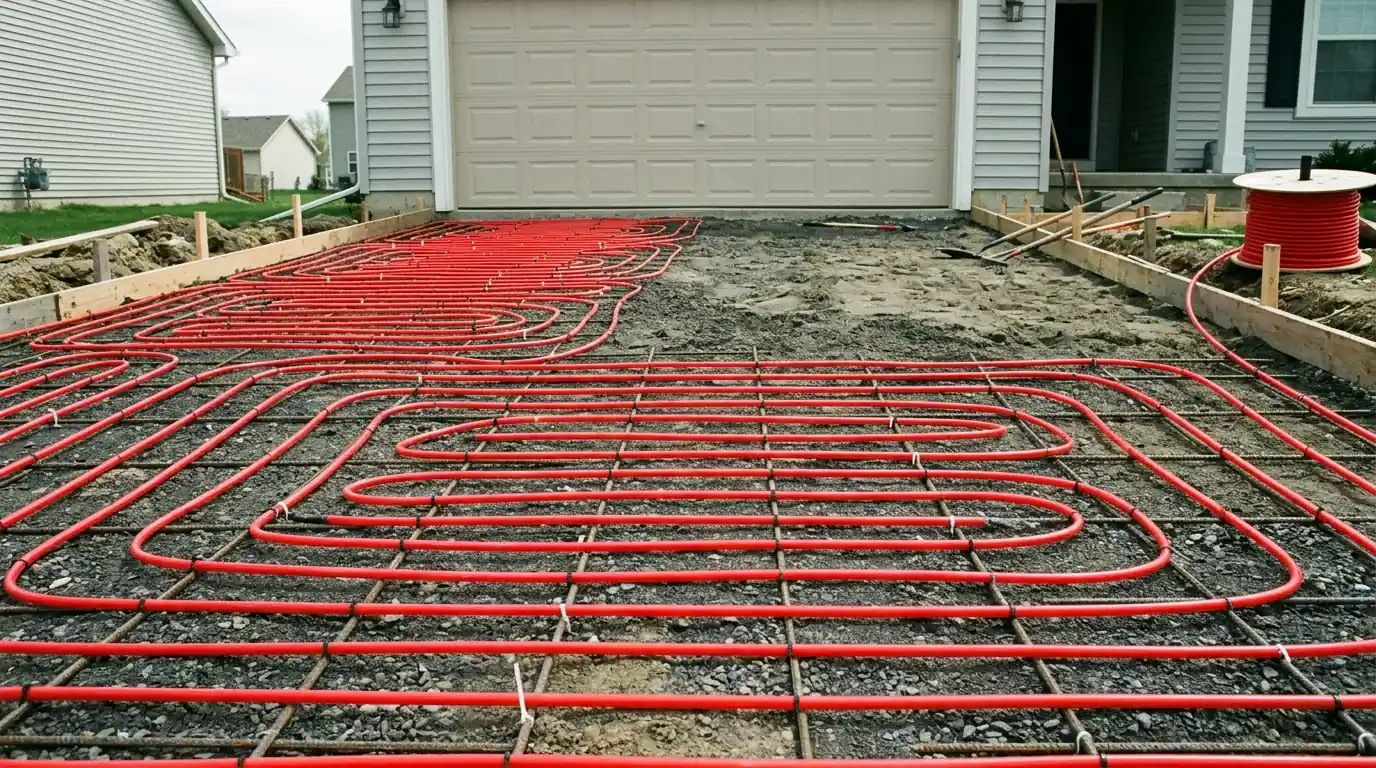
Tubing set in the base under the surface carries a warm glycol solution from a boiler, and an outdoor sensor turns the system on when it detects snow or ice at freezing temperatures. The slab warms just enough to melt snow as it lands, so there is nothing to plow and no salt to track inside or eat the concrete.
The heat comes from a boiler, often a dedicated high-efficiency unit; see boiler installation in Grand Rapids. Floors indoors use the same principle; see radiant floor heating.
Pricing, explained
What a snowmelt system costs depends on
Snowmelt pricing depends on the area melted, whether it goes in during a new pour, and the boiler and controls needed. We quote after measuring the area and seeing your existing heating.
Area
Whole driveway, tire tracks or walks and steps only.
Timing
Installing during a new pour avoids removing old concrete.
Boiler
A dedicated boiler or tie-in to existing capacity.
Controls
Snow and ice sensor, mixing valve and zones.
Surface
Concrete, pavers or asphalt need different setups.
Choosing between options
Full coverage or tire tracks
Both keep the drive usable; they differ in cost.
| Full driveway | Tire tracks only | |
|---|---|---|
| Area melted | Everything | Two strips |
| Install cost | Higher | Lower |
| Running cost | Higher | Lower |
| Best for | Steep or busy drives | Long, level drives |
What we install
Driveway and walkway snowmelt
Snowmelt has to go in with the paving, so we work with your concrete or paver contractor before the pour. Tubing is laid in loops on the prepared base at a spacing set by the heat needed, tied down, pressure tested and left under pressure through the pour so a damaged loop shows up immediately. Common layouts cover the whole driveway, just the tire tracks to cut cost, front walks, steps and the apron by the garage door where ice builds up first.
Boilers and controls for snowmelt
Melting snow takes a lot of heat for short periods, so the boiler is sized to the square footage and the melting rate you want. We install a high-efficiency boiler or tie into an existing one with enough capacity, add a heat exchanger to keep the glycol loop separate from the house heating, and set up a mixing valve so the slab warms gradually and is never shocked. An outdoor snow and ice sensor switches the system on and off automatically so it only runs when it is needed.
Snowmelt service and repair
Existing snowmelt systems need the same care as any boiler: an annual check of the boiler and its combustion, glycol tested and topped up so the loop cannot freeze, circulators and the mixing valve tested, and the sensor cleaned and checked. When a zone stops melting, the cause is usually a failed pump, an air-bound loop, a stuck zone valve or a faulty sensor, all of which can be fixed without touching the slab. A fall service visit before the first snow is the best time to catch them.
Local conditions
Snowmelt in West Michigan
West Michigan has the best-known example of snowmelt in the country: since 1988, downtown Holland has run a system that uses waste heat from power generation to keep about 690,000 square feet of streets and sidewalks clear, the largest publicly owned system in North America, with another 190,000 square feet of private snowmelt tied in. Home systems work the same way on a smaller scale, with a boiler supplying the heat.
From the call to a working system
How a snowmelt install runs
Measure and plan
Area, melt rate and boiler capacity worked out.
Coordinate the pour
Timed with your concrete or paver contractor.
Lay and test tubing
Loops laid, pressure tested and kept under pressure through the pour.
Boiler and controls
Boiler, heat exchanger, pumps and sensor installed.
Fill and start up
Glycol filled, system started and shown to you.
Timing
How long the install takes
Tubing goes down in a day or two ahead of the pour; the boiler and controls are finished once the surface has cured.
The paving schedule sets the timeline, so we plan with your contractor as soon as the job is booked.
Questions people ask us
Snowmelt questions
Only by replacing the surface; it goes in with a new pour or pavers.
No. A sensor turns it on only when snow or ice is present.
Often, unless your existing boiler has spare capacity.
Yes, it lowers both install and running costs.
Glycol keeps the outdoor loop from freezing.
Yes, with tubing set in the base below them.
The tubing lasts decades; the boiler is serviced like any other.
Yes, boilers, pumps, valves, sensors and glycol.
Pouring a new driveway?
Call before the pour and we will plan the snowmelt with you.