Condensation on windows
Winter humidity too high for the glass temperature.
Tight, well-insulated houses hold in heat and also hold in moisture, odors and stale air. A heat or energy recovery ventilator brings fresh air in without throwing away the heat.
The short answer
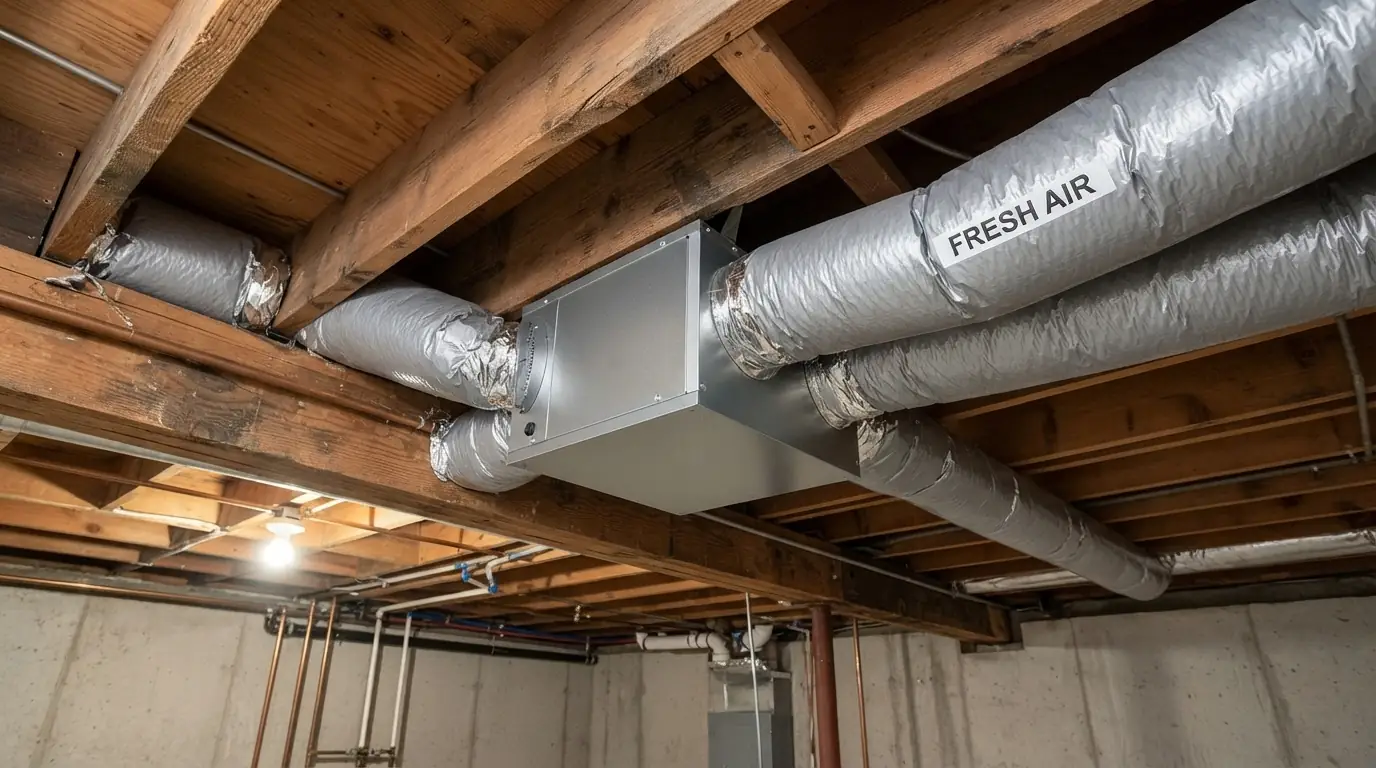
ERV and HRV installation in Grand Rapids adds a ventilator that exhausts stale indoor air and brings in fresh outdoor air, passing both streams through a core that transfers heat between them. An HRV recovers heat only; an ERV also moves some moisture. In winter, both bring in fresh air while recovering much of the heat that ventilation would otherwise waste.
Fresh air without the heat loss
Older houses leak enough air to ventilate themselves, badly. Newer and well-sealed houses do not, so moisture from cooking, showers and people builds up, windows sweat in winter and odors linger. Opening a window in January is not a real answer.
A ventilator runs continuously at a low rate and exchanges stale air for fresh. It works alongside the furnace and air conditioner, and pairs naturally with better filtration and humidity control.
Pricing, explained
Ventilation pricing depends on the ventilator size and how the air is distributed through the house. We quote after looking at the ductwork and the exhaust devices.
HRVs and ERVs of similar size are priced similarly.
Dedicated ducts cost more than using furnace ducts.
Supply and exhaust terminations need wall penetrations.
Timers, humidity controls and boost switches vary.
Airflow measurement and balancing are part of every install.
What ventilation fixes
Newer homes built to modern energy codes and older homes that have been air sealed and insulated both need a controlled fresh air supply. We size the ventilator to the house and the number of occupants, then choose how to distribute the air: through dedicated ducts to bedrooms and exhaust from bathrooms and the kitchen area, or simplified through the furnace ductwork. Each approach has trade-offs in cost and effectiveness, which we explain before choosing, and we balance the supply and exhaust airflows at start-up.

Bath fans, a range hood and a dryer all push air out of the house, and in a tight house that air has to come back from somewhere, often down a water heater flue or through a fireplace. A balanced ventilator brings in as much as it exhausts, so the house is not pulled negative. We look at every exhaust device in the house and how they interact with the ventilator and any atmospheric gas appliances, since balanced airflow is part of combustion safety.
Heavy condensation on windows in winter means indoor humidity is too high for the outdoor temperature, and in a tight house moisture has no easy way out. An HRV is the usual fix in cold climates, since it removes indoor moisture along with stale air while recovering heat. An ERV keeps more moisture in the house and suits homes that run dry in winter. We measure indoor humidity before recommending either, so the ventilator solves the actual problem rather than trading window condensation for dry winter air.
Local conditions
Grand Rapids houses stay closed from late fall until spring, so a tight house goes months without the incidental ventilation an open window provides. That is when moisture from showers and cooking shows up as frost and condensation on windows, especially on the north side of the house. A ventilator running steadily through the heating season keeps that moisture and stale air moving out.
Brands we service and install
From the call to a working system
Tightness, humidity, occupants and exhaust devices reviewed.
Matched to winter humidity and the house.
Dedicated or simplified distribution chosen.
Ventilator mounted, ducts run, exterior hoods fitted.
Supply and exhaust airflow measured and matched.
Timing
A simplified install using the furnace ductwork is usually finished in a day.
Fully ducted systems with dedicated supply and exhaust runs take one to two days, depending on how accessible the bedrooms and bathrooms are from below or above.
What you might notice
Winter humidity too high for the glass temperature.
Cooking and household smells that do not clear.
Closed rooms with no fresh air overnight.
Moisture sitting on cold surfaces.
Exhaust fans pulling the house negative.
Questions people ask us
Both recover heat; an ERV also transfers some moisture.
HRVs suit homes with winter condensation; ERVs suit homes that run dry.
Often it can handle bathroom exhaust through its own ducts.
Heat recovery warms incoming air using outgoing air.
Filters every few months; core cleaning yearly.
In a simplified install, yes, with some trade-offs.
Yes, an HRV removes excess indoor moisture.
Many tightly built new homes benefit from one.
From our guides: Winter humidity guide
More air quality & ducts work
Call and we will measure the humidity and plan ventilation.
Reach us
Service office
3535 3 Mile Rd NW, Grand Rapids, MI 49534